
Effort Up, Progress Sideways
Teams report green. Calendars are full. Yet the thing you said you'd move barely moves.
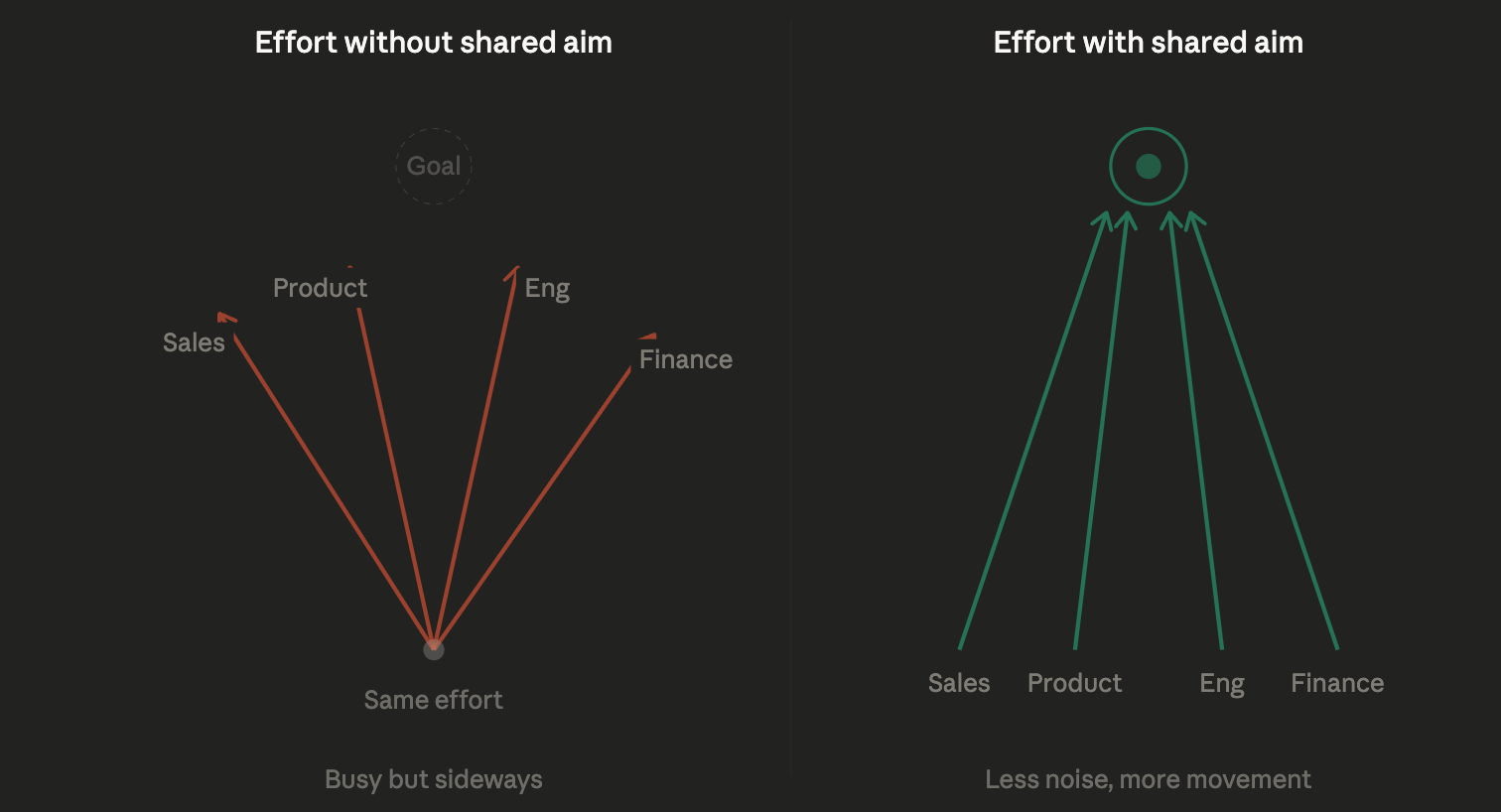
That's not a mystery. Something in the system — a person, a process, a metric, a client request — is aiming at a different target than the one you named. Not out of malice. Out of local logic that was never checked against the shared outcome.
The fix isn't more effort. It's tighter aim: make the intended outcome explicit, surface where actions point elsewhere, and change the local rules that keep the drift in place. Small moves, but they compound.
Here's how this shows up, why it sticks, what it costs, and what to do about it this week.
Where the Rift Shows Up First
Roles
The first signs often live in the seams between roles. Sales promises a capability framed as “just a minor tweak”. Product hears scope creep. Engineering hears risk with no time to test. Support hears a future wave of tickets. No one is wrong; they’re just aiming at different success definitions. Below you can find some cues on how to recognise them.
Subtle cues: repeated “quick question” pings after decisions that should be settled; a manager quietly rewriting goals in one-on-ones; two VPs both reporting progress, yet a shared milestone slips week after week.
Obvious cues: finger-pointing handoffs (“we delivered our part”), shadow spreadsheets to bypass the system, and new “urgent” work jumping the queue without a shared reframe.
Moments
Mis-aim shows up in decision moments: backlog grooming that treats all items as equal; a quarterly review where nobody can state the primary outcome in one sentence; a go/no-go where the loudest risk wins because criteria aren’t clear.
Subtle cues: meetings that end with “let’s keep moving” instead of “here’s what we’re moving toward”; a leader asking for “options” but never naming tradeoffs; status updates full of activity, thin on effect.
Obvious cues: last-minute deck rewrites that change the story, green dashboards paired with executive panic, and emergency all-hands to clarify something that should have been explicit for weeks.
Artifacts
Your documents tell on you. Roadmaps that list features, not outcomes. PRDs with “TBD” where success criteria should be. Contracts with vague “done” clauses. JIRA boards with hundreds of tickets and nothing to retire them.
Subtle cues: two versions of the same doc in circulation; comments that say “just to be safe”; test plans focused on passing checks, not protecting the experience you’re trying to change.
Obvious cues: customers repeating the same request across channels; a monthly metric that bounces without anyone asking what behavior actually changed.
Why the Drift Persists
It’s not that people don’t care. It’s that local incentives and missing signals make the wrong aim feel reasonable. It just makes sense to them. Some examples include:
1. Local scorecards reward outputs. A support team is measured on time to close, so they shape replies to be fast, not helpful. Marketing is tasked with volume, so quality leads are a nice-to-have. These aren’t bad actors. These are systems doing what they were told.
2. Decision rights are fuzzy. Who owns the outcome vs. who gets consulted? If every choice is a group chat, strong preferences from adjacent teams can nudge direction without anyone noticing the compounding effect.
3. Tools that hide the intent. Boards and dashboards show items and numbers, not purpose. A default workflow becomes a proxy for judgment. When the goal shifts—new client segment, cash constraints, regulatory change—the tools keep running the old plan.
Something to be mindful of: fear only works as an amplifier for this drift. If calling out the mismatch gets you labeled negative, people will quietly route around the blockages. Work still moves, just not toward the point. That's why pointing these out should be rewarded. If the topic at hand doesn't make sense, it's always better do have a discussion on why it's actually coherent, instead of just doubling down without revealing what it's truly optimised for.
What Happens If Nothing Shifts
The costs are real: attention, speed, and trust bleed out. You feel it before you can measure it.
Attention erodes. People stop reading long docs because they’ve learned the aim will change late. Meetings multiply because nothing stays decided. Slack fills with side channels where the “real” coordination happens.
Speed falters. Deadlines slide not from lack of effort but from rework. Every handoff adds translation tax. You ship more patches than progress, and the backlog turns into a museum of old intentions.
Trust thins. Teams pad estimates to create safety. Leaders ask for “more detail” instead of making a call. The best people self-select out because they want to build, not referee.
Picture a 40-person org with two VPs: one measured on growth, the other on gross margin. Both smart, both committed. Growth launches discounts and a new tier; margin freezes headcount and tightens approval on vendors. Both report wins. The company reports noise: churn inches up, support queues spike, and a core release slips because the same people are pulled into competing “urgent” work. Nothing catastrophic, just steady sideways.
What Changes When Aim Is Shared
When the intended outcome and its constraints are named and kept current, behavior shifts without heroics.
1st: Decisions get faster. You can say no without drama because no is tied to the aim. Tradeoffs become explicit: we’re protecting cash this quarter, so we’ll accept slower roadmap velocity. Or the reverse. People stop litigating taste. When people don't have the information to a whole story, their brains naturally assumes things and fills in details based on their own previous experiences or undiscovered bias.
2nd: Handoffs get cleaner. “Done” isn’t a vibe; it’s tied to a user change, a metric corridor, and a risk threshold. DMs drop because the plan answers the obvious questions and it allows people to operate from the shared frame. While it's still tempting to answer these things ad-hoc; keep referring to the documented plan.
And 3rd: Learning speeds up. When success tests are clear, misses teach you something instead of triggering blame. You can adjust one part of the system and see the effect, not spray fixes everywhere.
Clarity is not more words. It’s fewer words that people can act on.
Practical Countermeasures You Can Use This Week
These moves are small by design so that you can work with something that fits your situation. Pick the one that matches where the drift starts, cause depending on the root cause; different interventions are needed.
If goals and daily work feel disconnected
- - Write a one-sentence outcome with 2–3 success tests. Example: “Reduce onboarding time from signup to first value to under 10 minutes for 80% of new users, without increasing support contacts.” Put this at the top of every related doc, board, and meeting note. If the context shifts (cash, compliance, seasonality), update it and say so out loud.
- - Time-box the current plan. Give the goal a review date and a known owner. Drift loves timeless goals.
If decisions stall or wobble
- - Name a decision owner and the consult list. One owner, a short list of consulted roles, and a deadline. Everyone can suggest, one person decides, and the group commits. Document in one paragraph: situation, intended outcome, constraints. If new info shows up, you reopen it once, not in every meeting.
- - Define escalation triggers. For example: “If we exceed X error rate or Y cost, owner must escalate within 24 hours.” This keeps risk real without bogging down normal flow.
If metrics drive the wrong behaviour
- - Pair every metric with a guardrail. Speed with quality, volume with conversion, cost with satisfaction. Publish both. Celebrate when both sit in the corridor, not when one spikes and the other tanks.
- - Retire zombie numbers. If a metric no longer reflects today’s aim, archive it. Stale numbers are drift on a chart.
If handoffs create rework
- - Set an interface contract. One page that names inputs, outputs, definition of done, and who to page when things break. Keep it light. Update it after the first miss; one edit often removes ten frictions.
- - Add exit criteria to your workflow. A ticket moves when the success tests are met, not when someone is “done with my part”. Make the board reflect this reality.
If clients pull you off course
- - Create acceptance criteria you’ll actually enforce. Tie commitments to the shared outcome. “We can ship X by Y if we keep Z out of scope. If Z becomes required, delivery moves to Q2.” Say it early, write it plainly.
- - Run a short alignment check at kickoff. Ask the client to restate your outcome in their words. Mishearings caught here save months.
If tooling keeps the old plan alive
- - Version your plan in the tools. Add the current outcome and review date to your board description. Archive old columns and tags. Tools should show today’s aim, not last quarter’s.
- - Build one alert you’ll heed. For example: “If more than 20% of work is labelled urgent, we pause new intake until we find the source.”
If you want a lightweight way to formalize the habit, use a simple cadence: for any initiative with more than three people or two teams, start the week with a 15-minute capture of situation, intended outcome, and constraints; end the week with what moved the outcome and what blocked it. Keep the thread in one place so new decisions stack on the old.
But keep it concise and focused. Otherwise these sessions become another source for misalignment.
Some Signals to Watch
Early warnings that indicate misalignment
- - People can describe their task but not the effect it should have.
- - Leaders ask for more detail instead of making a call.
- - Urgent work grows but no shared reason why.
- - Docs multiply; the newest doesn’t supersede the rest.
- - Two teams report green while the joint goal is red or undefined.
Signs of progress that things are getting better
- - Shorter meetings, sharper no’s tied to the aim.
- - Handoffs name outcomes and risks in one screen or less.
- - Metrics move in pairs inside expected corridors.
- - People escalate on triggers, not personalities.
- - New work requests include how they serve the current outcome.
A Fair Objection: Isn’t Some Misalignment Healthy?
Creative tension matters. Separate teams should explore different options. If everyone thinks the same way, you’ll miss edge cases and new chances.
Here’s the line: explore widely, aim narrowly. Divergence is useful when it’s time-boxed and attached to a shared outcome. Two product ideas serving the same goal is healthy. Two goals living inside the same plan is a tug-of-war you’ll lose slowly.
So hold open space for challenge and alternatives, then commit. Write down the commitment and the constraint. Reopen it when the world changes, not when someone gets bored. That’s how you keep energy without losing direction.
Ready to gain clarity?
If a project feels busy but off-course, get in touch with us through the form on the homepage
Get in touch